
The U.S. Supreme Court dismissed Google’s appeal and forced the opening of the Andreau market for competition. Bureau
The United States Supreme Court recently dismissed the appeal by the Google parent company Alphabet for a stay of execution of the District Court ruling, which imposed a major reform of Google’s Play Appliance Shop. The legal dispute arose out of an antimonopoly suit filed by Epic Gomes, the developer of Fort Night.

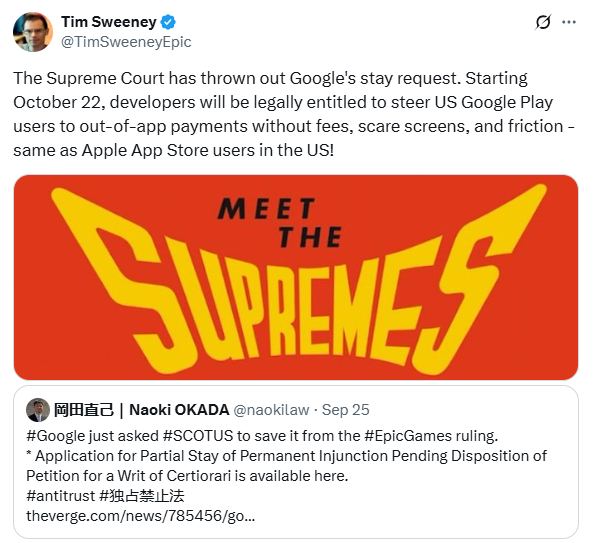
According to Reuters, the Chief Justice of the Supreme Court refused Google ‘ s request to freeze the effect of the partial injunctions, which Epic had won in the proceedings. Epic alleged that Google monopolized the application distribution channels on Android equipment and the application of intra-traffic payments. The injunction issued last year by the United States District Court judge, James Donato, contained two key provisions: requiring Google to allow users to download the competition’s app store through Play and to open the Play store’s application catalogue to competitors. These two provisions entered into force in July 2026. At the same time, the judge ruled that Google had to allow developers to embed external links in their applications to enable users to bypass the Google payment system, which would be implemented later this month. In its statement, Google expressed disappointment with the decision of the Supreme Court, but indicated that the appeal process would continue. Chief Executive Officer Tim Sweeney, Epic Games, praised the ruling, noting that the United States was increasingly competitive with suppliers who provided payment to developers and web-based shop solutions. “The Supreme Court has rejected Google’s request for a stay of execution”, he states, “from 22 October, the developer will have the right to direct United States Google Play users to the out-of-application payment system, without additional costs, from the warning interface and operational impediments”.
The case began with Epic ‘ s proceedings against Google in 2020, alleging that its restrictive application of shop rules violated antimonopoly law. In 2023, the San Francisco jury ruled in favour of Epic. Google has consistently denied the existence of misconduct and has called the decision of Judge James Donato “unprecedented” and, if effective, would entail reputational damage, security risks and a competitive disadvantage for companies. In its submission to the Supreme Court, Google warned that these changes would have far-reaching implications for over 100 million United States Android users and 500,000 developers. The company plans to file a full petition with the Supreme Court by 27 October.
According to Epic, Google relies on “deficient security claims” to preserve its control over Android equipment, and urges the Chancellor of Justice to maintain the effect of the ban so that “consumers and developers can benefit from competition, choice and lower prices”. In July this year, the Full Court of the Ninth Circuit of the United States upheld the sentence, stating that the record of proceedings was “filled with evidence that Google’s anti-competitive behaviour solidified its monopoly position”. In addition to the present case, Google faces a number of lawsuits brought by the Government, consumers and commercial plaintiffs challenging its search engine and advertising practice.

Related Posts

EA admits that the hand-drive Command and Conquest: The Enemies Away from the Core Experience has led to the subsequent re-establishment and opening of the classic.

GTA 6 re-emphasizes its PS5 monopoly strategy, with the core user being the host player